Subscribe:
Showing posts with label Verisign-Reseller. Show all posts

Tuesday, 26 July 2011

VASCO Reports Results for Second Quarter and First Six Months of 2011


Revenue for the second quarter of 2011 was $43.0 million, an increase of 74% compared to the second quarter of 2010; Operating income for the second quarter of 2011 was $3.4 million, an increase of 116% compared to the second quarter of 2010. Guidance for full-year revenue growth in 2011 over 2010 increased. Financial results for the period ended June 30, 2011 and guidance for full-year 2011 to be discussed on conference call today at 10:00 a.m. E.D.T.

OAKBROOK TERRACE, Ill. and ZURICH, July 26, 2011 /PRNewswire/ -- VASCO Data Security International, Inc. (Nasdaq: VDSI) (www.vasco.com), today reported financial results for the second quarter and six months ended June 30, 2011.

Revenue for the second quarter of 2011 increased 74% to $43.0 million from $24.7 million in the second quarter of 2010, and for the first six months of 2011, increased 63% to $79.3 million from $48.7 million for the first six months of 2010.  

Net income for the second quarter of 2011 was $2.6 million, or $0.07 per diluted share, an increase of $1.2 million, or 88%, from $1.4 million, or $0.04 per diluted share, for the second quarter of 2010.   Net income for the first six months of 2011 was$5.1 million, or $0.13 per diluted share, an increase of $3.1 million, or 160%, from $2.0 million, or $0.05 per diluted share, for the comparable period in 2010.

Other Financial Highlights:
Gross profit was $26.3 million, or 61% of revenue, for the second quarter of 2011 and $49.0 million, or 62% of revenue, for the first six months of 2011. Gross profit was $17.4 million and $34.1 million for the second quarter and first six months of 2010, respectively, or 70% of revenue for both periods of 2010.
Operating expenses for the second quarter and first six months of 2011 were $22.9 million and $42.5 million, respectively, an increase of 44% from $15.9 million reported for the second quarter of 2010 and an increase of 34% from $31.8 million reported for the first six months of 2010.
Operating expenses for the second quarter and first six months of 2011 included $0.8 million and $1.3 million, respectively, of expenses related to stock-based incentives.  Operating expenses for the second quarter and first six months of 2010 included $0.6 million and $1.2 million, respectively, of expenses related to stock-based incentives.    
Operating income for the second quarter and first six months of 2011 was $3.4 million and $6.5 million, respectively, an increase of $1.8 million, or 116%, from $1.6 million reported for the second quarter of 2010 and an increase of $4.2 million, or 181%, from $2.3 million reported for the first six months of 2010. Operating income as a percentage of revenue for the both second quarter and first six months of 2011 was 8% compared to 6% and 5% for the comparable periods in 2010.  
Earnings before interest, taxes, depreciation and amortization (EBITDA) was $5.3 million and $9.8 million for the second quarter and first six months of 2011, respectively, an increase of 134% from $2.2 million reported for the second quarter of 2010 and an increase of 159% from $3.8 million reported for the first six months of 2010.
Cash balances at June 30, 2011 totaled $84.6 million compared to $86.0 million and $85.5 million at March 31, 2011 and December 31, 2010, respectively.  There were no bank borrowings at any of the periods ended June 30, 2011, March 31, 2011 or December 31, 2010.

Operational and Other Highlights:
·         VASCO acquired Alfa & Ariss, a specialist in open identity and access management, on April 1, 2011.
·         VASCO's cloud-based DIGIPASS as a Service authentication was made available for Google™ Apps.
·         Belgian cloud service provider Thinfactory put DIGIPASS as a Service at the disposal of the end-users of its online web store.
·         VASCO entered the global SSL certificate market with CertiID SSL and EV SSL Certificates.
·         VASCO launched its CertiID managed PKI offering trusted certificates to corporations' employees and business partners.
·         VASCO launched DIGIPASS 836, a smart card reader with an optical interface and replaceable batteries.
·         The University of Colorado at Boulder used VASCO's DIGIPASS GO 6 and IDENTIKEY Server to secure access to its new supercomputer and its network.
·         Indiana University deployed VASCO's DIGIPASS to provide secure access to its institutional data and online applications.
·         Soliton Systems, a leading Japanese network solution vendor, embedded VACMAN® Controller in its Net'Attest EPS series product line, its all-in-one authentication server appliances.


Guidance for full-year 2011:
VASCO is revising its guidance for the full-year 2011 as follows:
·         Expected revenue growth of more than 40% for the full-year 2011 over full-year 2010, as compared to expected full-year revenue growth of more than 20% announced at the end of the first quarter of 2011; and
·         Operating margins, excluding expenses related to the amortization of acquisition-related intangible assets, for full-year 2011 are projected to be in the range of 8% to 12% of revenue, no change from guidance previously announced, but are expected to be at the lower end of the range.


"The second quarter of 2011 continued to show strong revenue growth from our traditional businesses," stated T. Kendall Hunt, Chairman & CEO.  "Revenues in the second quarter of 2011 were the highest in the company's history, reflecting strong growth from the banking market partially offset by a decline in revenues from the enterprise and application security market.   We expect to report strong revenue growth for full-year 2011 over 2010.  We believe that our strong order intake, which includes a significant number of orders scheduled to ship and invoice in 2011 and beyond, is an important and concrete sign that our business is gaining momentum.  We also continued to invest in our DIGIPASS as a Service product line.  The addition of Google™ Apps to our platform was a significant addition and we continue to work on integrating other important SAAS applications into our platform."

"In addition to our strong order intake, we have a strong pipeline of potential new orders and we expect that we will experience continued strong revenue growth in the second half of the year, driven primarily by the performance of the banking sector," stated Jan Valcke, VASCO's President and COO. "We also believe that our non-banking business will improve as a result of programs designed to support our reseller channel and their efforts.  With the projected strong growth in revenues from the banking market in 2011, which includes high volume transactions with lower average selling prices, we expect our gross margins as a percentage of revenue will continue to be below the comparable quarters of 2010.  Looking forward, we believe that as the performance from our non-banking business improves and our services strategy gains traction, our gross margins will improve."

Conference Call Details
In conjunction with this announcement, VASCO Data Security International, Inc. will host a conference call today, July 26, 2011, at 10:00 a.m. EDT - 16:00h CET.  During the Conference Call, Mr. Ken Hunt, CEO, Mr. Jan Valcke, President and COO, and Mr.Cliff Bown, CFO, will discuss VASCO's Results for the Second Quarter and First Six Months Ended June 30, 2011.

To participate in this Conference Call, please dial one of the following numbers:

USA/Canada: +1 800-268-2160
International:  +1 303-223-4375

And mention VASCO to be connected to the Conference Call.

The Conference Call is also available in listen-only mode on www.vasco.com. Please log on 15 minutes before the start of the Conference Call in order to download and install any necessary software. The recorded version of the Conference Call will be available on the VASCO website 24 hours a day for at least 60 days.

RapidSSL Wildcard Services

Sunday, 10 July 2011

Phishing Sites Explode on the Web

Online criminals are thriving even in the face of new automated defenses.


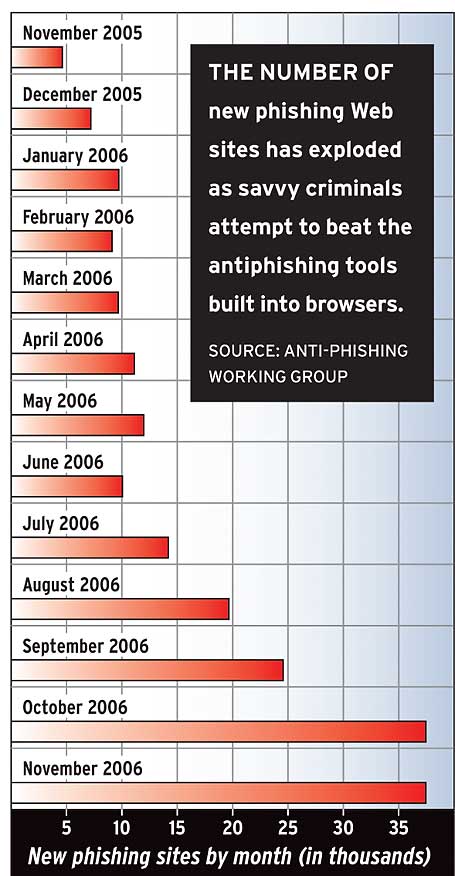
Think the new built-in phishing filters in Internet Explorer 7 and Firefox 2 will protect your private data? Think again. The number of sites devoted to phishing skyrocketed last year, and the number of Americans taken in by phishing schemes has nearly doubled. In November 2006, the last month for which data is available, the Anti-Phishing Working Group found 37,439 new sites, up an astounding 709 percent from the 4630 sites in November of 2005. (Click on the "Image Enlargement" icon above to see the chart showing this trend.)
Last October, both Mozilla and Microsoft released new versions of their browsers that use blacklists to block access to known phishing sites. In response, resourceful phishes are flooding new fake Web sites onto the Internet too quickly for them all to be shut down or blacklisted.
The alarming ease, with which the fraudsters changed course, plus other new phishing tactics, makes some security experts say that phishes have the upper hand in the war against online fraud.
"Ultimately," warns Zulfikar Ramzan, who is a senior principal researcher with Symantec's Security Response Group, "technologies that rely heavily on blacklists are going to be useless."
Easy Phishing
According to RSA, a security vendor, hackers in January started selling a phishing kit that lets criminals set up very convincing fake Web sites with little effort. The fake site pulls images and layouts from the real site, usually a bank or other financial institution, and passes the user's information back to the real site to mimic a regular log-in--while keeping a copy of the account data for the criminals.
The draw, of course, is ever-increasing profits. Research firm Gartner estimates that 3.5 million Americans gave up sensitive information to phishers in 2006, an 84 percent jump from the previous year--for a total loss of $2.8 billion. One single phishing gang, called Rock Phish, is estimated to have taken in more than $100 million.
According to security experts, Rock Phish has pioneered many of the techniques that have contributed to the recent jump in phishing sites. And the image spam that hides its pitch from filters by embedding it in a picture was a Rock Phish invention, these experts say. On some days this one group, which specializes in spoofing U.S. and European financial institutions, may account for as many as one-half of all the phishing sites in operation, according to researchers.
Heuristic scanning may help combat the scourge. Instead of depending on a blacklist of known phishing sites, it analyzes a site's behavior, looking for techniques commonly used by phishes. IE 7 uses heuristics, as does the free Site Advisor browser add-on for IE and Firefox.
An emerging standard for a new type of site certification--called Extended Validation Secure Sockets Layer, or EV SSL--may also help. To get this certificate, sites will have to be checked out by third parties like VeriSign or Entrust to make sure that they at least appear to be legitimate. On such sites, the browser address bar will turn green.
Microsoft supports EV SSL in its IE 7 browser, and major online-commerce sites such as PayPal have now started to come on board as well.
But if the current surge in phishing sites demonstrates anything, it's that phishes can and do get around automated tools and procedures to protect their sizable profits. Recently they have been developing new technologies that could well thwart protection measures like EV SSL Certificate, according to Aviva Litany, a Gartner analyst.
Litan, who doubts EV SSL Certificate will have much impact on phishing, believes security technology firms deserve some of the blame for the growing phishing threat.
"The security industry has been a little arrogant," she explains. "I don't think that people realize how sophisticated these [online] criminals are."
Best Defense
Although no magic bullet may exist now (or ever) to safeguard us all, there is one simple way to protect yourself from the majority of phishing attempts: Never click a link in an e-mail or on a third-party site to go to any of your financial accounts. If, instead, you always use your own bookmark or type in the address, even when you're 100 percent certain that the e-mail is legitimate, you should be safe.
Automated tools, such as the free Password Safe and PwdHash utilities can still provide help. But to combat ever-adapting phishers, your best protection remains...you.


Monday, 4 July 2011

GeoTrust again win and Beats Go Daddy in Battle of SSL Market Share


GeoTrust is again top of the SSL market share in top websites, according to the latest "Alexa Netcraft Index," a monthly research on Secure Sockets Layer (SSL) certificate used around the world.

In the Alexa index of GeoTrust, a primary SSL certificate authority (CA) secured 20.6 % of exclusive domains in the million most visited sites. The VeriSign is 17.9% of all exclusive domains. Go daddy again was third with 15.6% share.

The latest results show GeoTrust is repeated front in the high-volume; low-cost SSL market remains unchallenged. In this business market segment, low prices make purchase decisions in SSL customers whose main purpose is to encrypt data transferred to and from the sites. On the other side, the VeriSign brand go ahead the premium SSL certificate and online trust, where customers demand full business certification, seal-in-search, daily Malware scans, and other extended services in addition to encryption.

With SSL certificates issued in more than 150 countries in the world, GeoTrust offers outstanding SSL certificates with fast delivery at low value. Enabling up to 256-bit SSL encryption, they include a range of GeoTrust® True Site seals based on the preferred level of identity authentication.

If you do Transaction online, you are alert of the meaning of get a customer satisfaction to ensure they feel secure and able to complete the transactions. Best way to get the trust is SSL certificates. It is importance you trust on your SSL certificate vendor. Like GeoTrust is Top in the fulfilling of customer satisfaction so it is top in the battle of SSL certificate market share.

GeoTrust SSL certificate arrive with fast delivery a lowest price. Strong encryption, multi-domain support with extended validation options. When it comes to end users satisfaction, going with a reputed trade name is very necessary. GeoTrust is broadly popular respected to Go Daddy.

Warranty is also main factor of company. Incase if steal your personal information like Credit card information GeoTrust warranty ranges is $10,000 to $250,000 compared to Go Daddy’s $2000 warranty.

TheSSLstore.com is one of the largest SSL Certificates providers globally. Platinum partner forVeriSign, GeoTrust, Thawte and RapidSSL. Among the Internet security solutions TheSSLstore.com offers are SSL certificates from VeriSign, Thawte, GeoTrust, and RapidSSL. We buy SSL certificates in large quantities and pass the savings to you. To learn more about SSL Certificates visit
https://www.thesslstore.com

Tuesday, 21 June 2011

SSL Certificates In VMware View Environments


An SSL certificate could be described as a data container that includes the identity of a computer, the public key and the digital signature of the publisher of the certificate. Certificates are used to confirm the authenticity of a website, or the the public key contained can be used to encrypt the connection between a client and a server.
Making no further action the View Server is using a self-signed certificate. When you open the website of the View Server it gives you a security warning back that states that the certificate comes from an untrusted source.
To use your own certificates that have been signed from a trusted Certification Authority (CA), you can use the keytool that comes with the view installation on the Connection Server. With this tool, you create a trust store on the View Server, where your certificates  can be integrated. Request a certificte from an authorized CA. This may be the CA of your company, or a third party such as thawte, VeriSign and GlobalSign. It is also possible to integrate already-signed certificates for your server. In the next section, you can read the entire process for requesting a certificate from the Microsoft Certification Authority. For certificates from other parties, please refer to their documentation.
Certificates are only used by Connection Servers which are having direct connections with the clients. If you are using the Security Server for connections the certificate is needed only by this server.
Companies that use the Active Directory as their directory service, also often use  the Microsoft Certification Authority for their security certificates. The following example explains the steps needed to apply for a certificate and then to integrate this in a VMware View Server. First, you must apply for a certificate from the CA. Use the Microsoft Internet Explorer on the View Server because only with this browser the import and export of the certificate works without problems. "Open the Internet Explorer and type the correct address of your certification server in the address bar."This should be <certificatesrevername.fqdn>/certsrv/.Replace the wildcard certificate server name with the computer name of the appropriate server and fqdn with the fully qualified DNS domain name. 

Apply for a certificate on the website and mark it as exportable. After the newly requested certificate has been approved you revisit the site with Microsoft Internet Explorer and install the issued certificate. The certificate will be stored in the local certificate store now and you can export it in a file from there. In Internet Explorer perform the following action.  Click on the Tools menu and select Internet Options." This will open a window where you can change the properties and options of your Internet Explorer. 

»Select content from the tab and then click the button labeled Certificates. In the following dialog you have to select the certificate of your server and then export it to a directory on your hard disk. It is important that you export the certificate with the private key in the PFX file format. Name the certificate i.e. as server.pfx. After that you’ve to export the certificate for the CA of your company in the file format X509.

After a successful export of both security certificates, the trust store can be created. You have to use the keytool application. To use the application you should first adjust the environment variables on your computer so that the keytool can run without using long file paths. Open a Windows command line on the View server and type the following command:
set PATH =% PATH%,% Program Files% VMware \ VMware View \ Server \ jre \ bin \

Then switch the command prompt to the  directory where you’ve saved the certificates. Using the exported CA certificate in the keytool you’ll now generate the truststore. Replace <ca-alias name> by the name of the Certification Authority and <ca-certificate name.ce> by the real name of the CA certificate.
keytool-import-alias-file <ca-alias name> <ca-certificate name.ce>-keystore truststore

The newly created trust store and the PFX certificate must be copied to the subdirectory \sslgateway\conf in the program directory of the VMware Server View. If there is no file namedlocked.properties in the directory you’ve to create it as normal text file with Notepad. Otherwise, you open the existing file and modify it with the following parameters.

keyfile = server.pfx
keypass = <secret>
trustKeyfile = truststore
truststore type = JKS
useCertAuth = true

Please ensure that you’ve the correct password for the certificate in the keypass parameter. Afterwards the View Connection Server service must be restarted. This can be done via the Windows Services Manager. Check the Windows Event Log and the View server log files underc: \documents and settings\all users\application data\ vdm\logs for errors. If the View Connection Server service is not strating, there might be an issue with the certificate or password.

SSL Top News & Offers Of VeriSIgn:-

Get 13 Months of VeriSign Secure Site Pro with EV Security Now for the Price of 12 Months with TheSSLstore.com

Buy or Renew VeriSign Secure Site Pro EV Security for 13 Months at TheSSLstore only.

Pricing:
VeriSign Secure Site Pro with EV @ $1199.00 for 13 months

TheSSLstore is a Fully Authorized Platinum Partner of the VeriSign Secure Site Pro EV SSL Certificate. TheSSLstore has an exclusive offer for VeriSign Secure Site Pro with EV SSL Certificates. Buy or Renew VeriSign Secure Site Pro with EV for 13 months @ $1199.00 with TheSSLstore.com.
Get instant access to this VeriSign Secure Site Pro with EV SSL exclusive offer:

https://www.thesslstore.com/verisign/verisign-specials.aspx

OR
https://www.thesslstore.com


Thursday, 16 June 2011

Embed strong authentication into mobile applications

To improve the speed and efficiency in which financial institutions develop and provide customes secure, trusted mobile banking applications, Entrust announces their Identity Guard Mobile SDK for mobile platforms. This security toolkit helps banks transparently embed Entrusts strong authentication technology into an organization's new or existing mobile-banking application.

From e-mail communication, social networking, banking, commerce, shopping and personal entertainment, mobile devices have enabled a radical shift in the manner in which organizations can now service their customers. But the growth in mobile devices and the drive to move more services to the mobile channel has also increased incidences of fraud targeting these devices.

The SDK also will assist financial institutions with deploying stronger authentication for online customer security, a requirement expected to be at the center of upcoming guidance from regulatory agencies of the Federal Financial Institutions Examination Council (FFIEC).

The organization's 2005 guidance took a strong stance in support of the deployment of stronge authentication methods, as well as fraud detection techniques, to protect customer identities and information during online banking transactions. But advances in criminal technology demands stronger guidelines to help stop advanced attacks that target the identities and transactions of consumers and business-banking customers.

Embedding OTP tokens is more cost-effective than purchasing, issuing and deploying hardwar tokens because it leverages devices that are already widely deployed — increasing user acceptance. This transparent approach meets mobile user expectations of quick, simple application access and helps application providers build a consistent brand between their mobile application and online presence.

For software developers creating mobile applications, security is often a secondary concern yet needed to help comply with regulatory guidelines for the financial industry, such as those provided by the FFIEC. But because of its straightforward APIs, the Entrust Identity Guard Mobile SDK allows developers to easily design and implement identity-based security into their branded mobile applications without sacrificing usability or transparency for end-user adoption.

The SDK provides a number of capabilities that enables features such as transparent strong mobile authentication, soft token display to address online banking security and out-of-band transaction verification to help defeat advanced fraud attacks such as man-in-the-browser. With support for the most popular platforms, the toolkit delivers a common API framework that allows developers to leverage integration efforts across multiple development environments.

TheSSLstore.com provide the EV SSL Certificate at discounts through its Platinum Partnership with VeriSign, GeoTrust, Thawte, and RapidSSL, offering SSL certificates at steeply discounted rates, 24/7 support, and a 30-day money back guarantee. TheSSLstore is one of the largest and most trusted SSL certificate providers globally, with clients ranging from NASA and IBM to thousands of small businesses.